SharedPreferences
1、加载/初始化
维护spName–>file,file–>sharedPreferencesImpl两个ArrayMap内存缓存
ContextImpl.java
@Override
    public SharedPreferences getSharedPreferences(String name, int mode) {
        File file;
        synchronized (ContextImpl.class) {
            if (mSharedPrefsPaths == null) {
                mSharedPrefsPaths = new ArrayMap<>();
            }
            file = mSharedPrefsPaths.get(name);
            if (file == null) {
                file = getSharedPreferencesPath(name);
                mSharedPrefsPaths.put(name, file);
            }
        }
        return getSharedPreferences(file, mode);
    }
    @Override
    public SharedPreferences getSharedPreferences(File file, int mode) {
        SharedPreferencesImpl sp;
        synchronized (ContextImpl.class) {
            final ArrayMap<File, SharedPreferencesImpl> cache = getSharedPreferencesCacheLocked();
            sp = cache.get(file);
            if (sp == null) {
                checkMode(mode);
                sp = new SharedPreferencesImpl(file, mode);
                cache.put(file, sp);
                return sp;
            }
        }
        return sp;
    }
SharedPreferencesImpl构造方法切子线程loadFromDisk,得到Map<String, Object> mMap
SharedPreferencesImpl.java
    SharedPreferencesImpl(File file, int mode) {
        mFile = file;
        mBackupFile = makeBackupFile(file);
        mMode = mode;
        mLoaded = false;
        mMap = null;
        mThrowable = null;
        startLoadFromDisk();
    }
    private void startLoadFromDisk() {
        new Thread("SharedPreferencesImpl-load") {
            public void run() {
                loadFromDisk();
            }
        }.start();
    }
private void loadFromDisk() {
    synchronized (mLock) {
        if (mLoaded) {
            return;
        }
        if (mBackupFile.exists()) {
            mFile.delete();
            mBackupFile.renameTo(mFile);
        }
    }

         str = new BufferedInputStream(new FileInputStream(mFile), 16 * 1024);
         map = (Map<String, Object>) XmlUtils.readMapXml(str);

  synchronized (mLock) {
            mLoaded = true;
            mThrowable = thrown;
            // It's important that we always signal waiters, even if we'll make
            // them fail with an exception. The try-finally is pretty wide, but
            // better safe than sorry.
            try {
                  mMap = map;
            } catch (Throwable t) {
                mThrowable = t;
            } finally {
                mLock.notifyAll();
            }
        }
edit: wait util loaded
@Override
public Editor edit() {
    // TODO: remove the need to call awaitLoadedLocked() when
    // requesting an editor.  will require some work on the
    // Editor, but then we should be able to do:
    //
    //      context.getSharedPreferences(..).edit().putString(..).apply()
    //
    // ... all without blocking.
    synchronized (mLock) {
        awaitLoadedLocked();
    }

    return new EditorImpl();
}
awaitLoadedLocked
    @GuardedBy("mLock")
    private void awaitLoadedLocked() {
        while (!mLoaded) {
            try {
                mLock.wait();
            } catch (InterruptedException unused) {
            }
        }
    }
putXxx: mModified.put(key, value)
@Override
public Editor putString(String key, @Nullable String value) {
    synchronized (mEditorLock) {
        mModified.put(key, value);
        return this;
    }
}
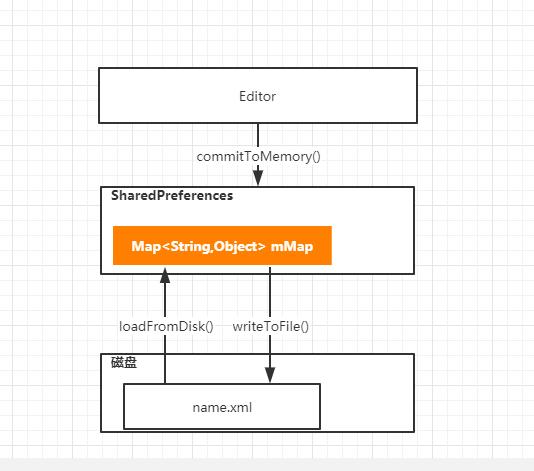
getXXX() 导致ANR
public String getString(String key, @Nullable String defValue) {
    synchronized (mLock) {
        awaitLoadedLocked();
        String v = (String)mMap.get(key);
        return v != null ? v : defValue;
    }
}
2、编辑提交
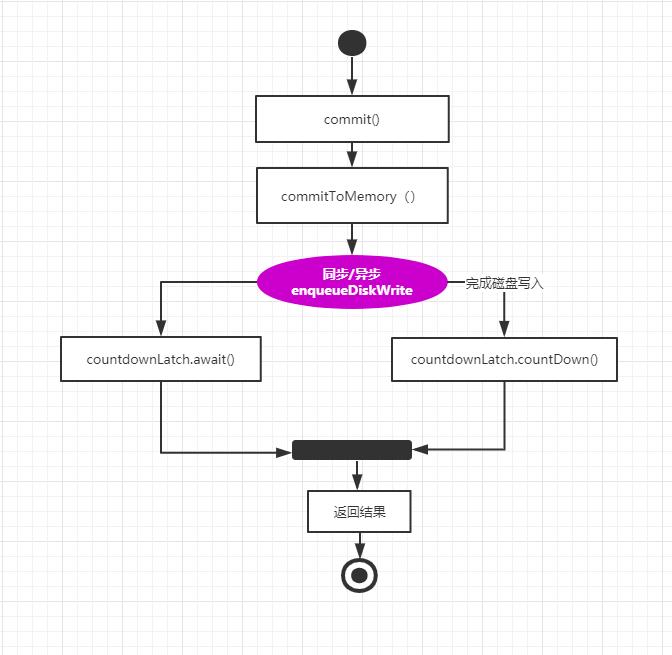
2.1、 commit()流程
@Override
public boolean commit() {
    MemoryCommitResult mcr = commitToMemory();
    SharedPreferencesImpl.this.enqueueDiskWrite(mcr, null /* sync write on this thread okay */);
    try {
        mcr.writtenToDiskLatch.await();
    } catch (InterruptedException e) {
        return false;
    }
    notifyListeners(mcr);
    return mcr.writeToDiskResult;
}
2.1.1 commitToMemory
        // Returns true if any changes were made
        private MemoryCommitResult commitToMemory() {
            long memoryStateGeneration;
            List<String> keysModified = null;
            Set<OnSharedPreferenceChangeListener> listeners = null;
            Map<String, Object> mapToWriteToDisk;

            synchronized (SharedPreferencesImpl.this.mLock) {
                mapToWriteToDisk = mMap;

                synchronized (mEditorLock) {
                        for (Map.Entry<String, Object> e : mModified.entrySet()) {
                        String k = e.getKey();
                        Object v = e.getValue();
                        // "this" is the magic value for a removal mutation. In addition,
                        // setting a value to "null" for a given key is specified to be
                        // equivalent to calling remove on that key.
                        if (v == this || v == null) {
                            if (!mapToWriteToDisk.containsKey(k)) {
                                continue;
                            }
                            mapToWriteToDisk.remove(k);
                        } else {
                            if (mapToWriteToDisk.containsKey(k)) {
                                Object existingValue = mapToWriteToDisk.get(k);
                                if (existingValue != null && existingValue.equals(v)) {
                                    continue;
                                }
                            }
                            mapToWriteToDisk.put(k, v);
                        }

                        changesMade = true;
                    }
                    return new MemoryCommitResult(memoryStateGeneration, keysModified, listeners,
                    mapToWriteToDisk);
                }
            }
2.2.2 enqueueDiskWrite
    private void enqueueDiskWrite(final MemoryCommitResult mcr,
                                  final Runnable postWriteRunnable) {
        final boolean isFromSyncCommit = (postWriteRunnable == null);

        final Runnable writeToDiskRunnable = new Runnable() {
                @Override
                public void run() {
                    synchronized (mWritingToDiskLock) {
                        writeToFile(mcr, isFromSyncCommit);
                    }
                    synchronized (mLock) {
                        mDiskWritesInFlight--;
                    }
                    if (postWriteRunnable != null) {
                        postWriteRunnable.run();
                    }
                }
            };

        // Typical #commit() path with fewer allocations, doing a write on
        // the current thread.
        if (isFromSyncCommit) {
            boolean wasEmpty = false;
            synchronized (mLock) {
                wasEmpty = mDiskWritesInFlight == 1;
            }
            if (wasEmpty) {
                writeToDiskRunnable.run();
                return;
            }
        }

        QueuedWork.queue(writeToDiskRunnable, !isFromSyncCommit);//add to sWork
    }
QueuedWork.queue
- 当apply()方式提交的时候,默认消息会延迟发送100毫秒,避免频繁的磁盘写入操作。
- 当commit()方式,调用QueuedWork的queue()时,会立即向handler()发送Message。
    /** Delay for delayed runnables, as big as possible but low enough to be barely perceivable */
    private static final long DELAY = 100;

    public static void queue(Runnable work, boolean shouldDelay) {
        Handler handler = getHandler();
        synchronized (sLock) {
            sWork.add(work);

            if (shouldDelay && sCanDelay) {
                handler.sendEmptyMessageDelayed(QueuedWorkHandler.MSG_RUN, DELAY);
            } else {
                handler.sendEmptyMessage(QueuedWorkHandler.MSG_RUN);
            }
        }
    }
getHandler
    /**
     * Lazily create a handler on a separate thread.
     */
    private static Handler getHandler() {
        synchronized (sLock) {
            if (sHandler == null) {
                HandlerThread handlerThread = new HandlerThread("queued-work-looper",
                        Process.THREAD_PRIORITY_FOREGROUND);
                handlerThread.start();
                sHandler = new QueuedWorkHandler(handlerThread.getLooper());
            }
            return sHandler;
        }
    }
    private static class QueuedWorkHandler extends Handler {
        static final int MSG_RUN = 1;

        QueuedWorkHandler(Looper looper) {
            super(looper);
        }

        public void handleMessage(Message msg) {
            if (msg.what == MSG_RUN) {
                processPendingWork();
            }
        }
    }
processPendingWork
    private static void processPendingWork() {
        long startTime = 0;
        synchronized (sProcessingWork) {
            LinkedList<Runnable> work;

            synchronized (sLock) {
                work = (LinkedList<Runnable>) sWork.clone();
                sWork.clear();

                // Remove all msg-s as all work will be processed now
                getHandler().removeMessages(QueuedWorkHandler.MSG_RUN);
            }

            if (work.size() > 0) {
                for (Runnable w : work) {
                    w.run();
                }
            }
        }
    }
writeToFile
private void writeToFile(MemoryCommitResult mcr, boolean isFromSyncCommit) {
        boolean fileExists = mFile.exists();
         // Rename the current file so it may be used as a backup during the next read
         if (fileExists) {
          boolean backupFileExists = mBackupFile.exists();
            if (!backupFileExists) {
                if (!mFile.renameTo(mBackupFile)) {
                    Log.e(TAG, "Couldn't rename file " + mFile + " to backup file " + mBackupFile);
                    mcr.setDiskWriteResult(false, false);
                    return;
                }
            } else {
                mFile.delete();
            }
        }

        // Attempt to write the file, delete the backup and return true as atomically as
        // possible.  If any exception occurs, delete the new file; next time we will restore
        // from the backup.
        try {
            FileOutputStream str = createFileOutputStream(mFile);
            XmlUtils.writeMapXml(mcr.mapToWriteToDisk, str);
            FileUtils.sync(str);
            str.close();

            // Writing was successful, delete the backup file if there is one.
            mBackupFile.delete();
            mcr.setDiskWriteResult(true, true);
       void setDiskWriteResult(boolean wasWritten, boolean result) {
            this.wasWritten = wasWritten;
            writeToDiskResult = result;
            writtenToDiskLatch.countDown();
        }
2.2、 apply()流程
public void apply() {
    final MemoryCommitResult mcr = commitToMemory();
    final Runnable awaitCommit = new Runnable() {
            @Override
            public void run() {
                try {
                    mcr.writtenToDiskLatch.await();
                } catch (InterruptedException ignored) {
                }
            }
        };

    QueuedWork.addFinisher(awaitCommit);

    Runnable postWriteRunnable = new Runnable() {
            @Override
            public void run() {
                awaitCommit.run();
                QueuedWork.removeFinisher(awaitCommit);
            }
        };

    SharedPreferencesImpl.this.enqueueDiskWrite(mcr, postWriteRunnable);
    notifyListeners(mcr);
}
apply 接口整体的详细设计思路如下图(基于 Android8.0 及以下版本分析):
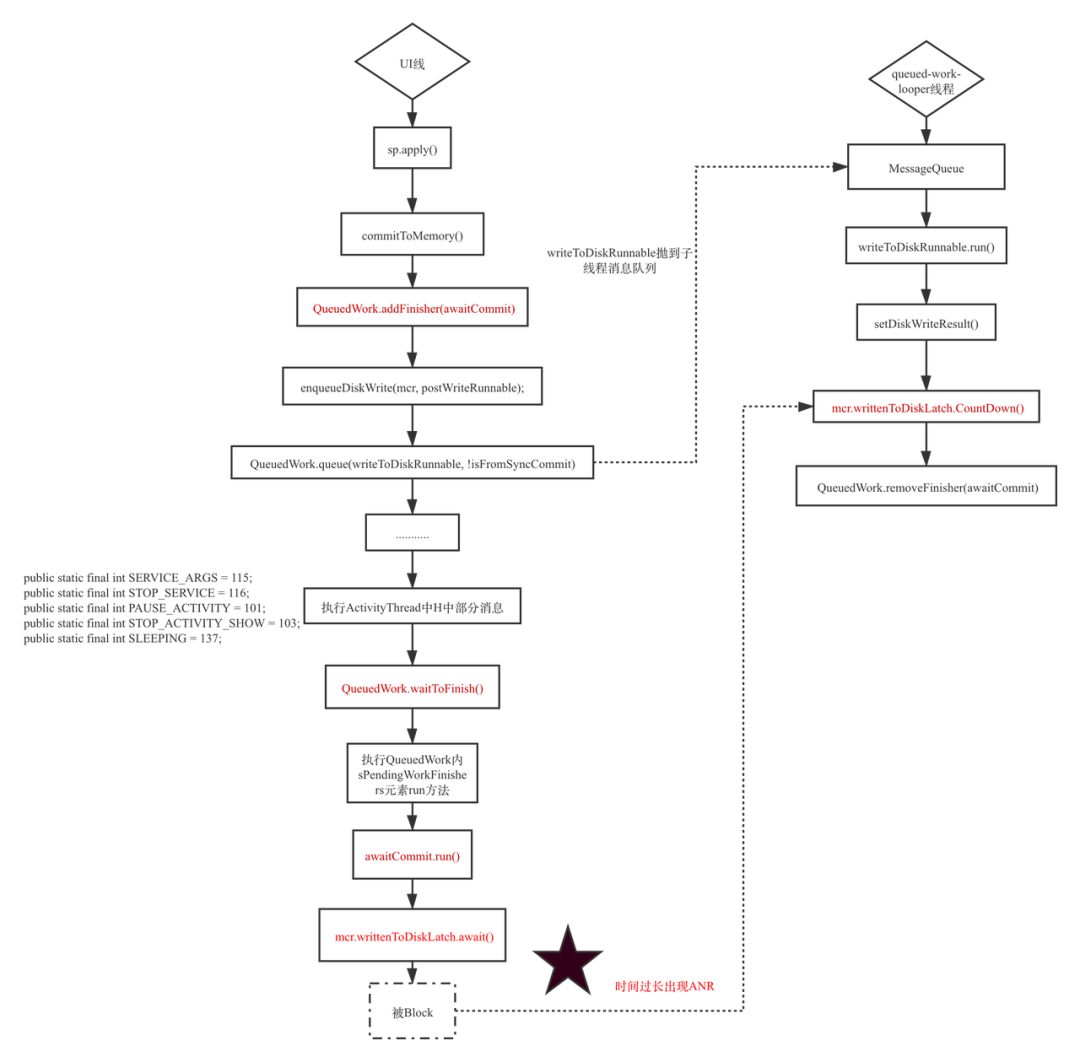
尽管 Google 官方在 Android 8.0 及以后版本对 sp 写入逻辑进行优化,期望是在上述步骤 6 中 UI 线程不是傻傻的等,而是帮助子线程一起写入,但是由于是保守协助,并没有很好的解决这个问题。
2.3 主线程堵塞ANR
为了保证异步任务及时完成,当生命周期处于 handleStopService() 、handlePauseActivity() 、 handleStopActivity() 的时候会调用QueuedWork.waitToFinish() 会等待写入任务执行完毕。
waitToFinish,processPendingWork
You don’t need to worry about Android component lifecycles and their interaction with apply() writing to disk. The framework makes sure in-flight disk writes from apply() complete before switching states.
//QueuedWork.java
    /**
     * Trigger queued work to be processed immediately. The queued work is processed on a separate
     * thread asynchronous. While doing that run and process all finishers on this thread. The
     * finishers can be implemented in a way to check weather the queued work is finished.
     *
     * Is called from the Activity base class's onPause(), after BroadcastReceiver's onReceive,
     * after Service command handling, etc. (so async work is never lost)
     */
    public static void waitToFinish() {
        processPendingWork();//write to disk and run postWriteRunnable, will block main thread
            while (true) {
                Runnable finisher;
                synchronized (sLock) {
                    finisher = sFinishers.poll();
                }
                finisher.run();
            }
    }
waitToFinish()会将,储存在QueuedWork的操作一并处理掉。什么时候呢?在Activiy的 onPause()、BroadcastReceiver的onReceive()以及Service的onStartCommand()方法之前都会调用waitToFinish()。大家知道这些方法都是执行在主线程中,一旦waitToFinish()执行超时,就会抛出ANR。
至于waitToFinish调用具体时机,查看ActivityThread.java类文件。这里只是说本质原理
线程安全
多操作线程安全
为了保证SharedPreferences是线程安全的,Google的设计者一共使用了3把锁:
对于简单的 读操作 而言,我们知道其原理是读取内存中mMap的值并返回,那么为了保证线程安全,只需要加一把锁保证mMap的线程安全即可:
mMap相关的mLock锁
public String getString(String key, @Nullable String defValue) {
    synchronized (mLock) {
        String v = (String)mMap.get(key);
        return v != null ? v : defValue;
    }
}
写操作线程安全
对于写操作而言,每次putXXX()并不能立即更新在mMap中,这是理所当然的,如果开发者没有调用apply()方法,那么这些数据的更新理所当然应该被抛弃掉,但是如果直接更新在mMap中,那么数据就难以恢复。
因此,Editor本身也应该持有一个mEditorMap对象,用于存储数据的更新;只有当调用apply()时,才尝试将mEditorMap与mMap进行合并,以达到数据更新的目的。
因此,这里我们还需要另外一把锁保证mEditorMap的线程安全,笔者认为,不和mMap公用同一把锁的原因是,在apply()被调用之前,getXXX和putXXX理应是没有冲突的。
代码实现参考如下:
EditorImpl相关的mEditorLock锁
public final class EditorImpl implements Editor {
  @Override
  public Editor putString(String key, String value) {
      synchronized (mEditorLock) {
          mEditorMap.put(key, value);
          return this;
      }
  }
}
而当真正需要执行apply()进行写操作时,mEditorMap与mMap进行合并,这时必须通过2把锁保证mEditorMap与mMap的线程安全,保证mMap最终能够更新成功,最终向对应的xml文件中进行更新。
文件的更新理所当然也需要加一把锁:
写文件时的锁mWritingToDiskLock
// SharedPreferencesImpl.EditorImpl.enqueueDiskWrite()
synchronized (mWritingToDiskLock) {
    writeToFile(mcr, isFromSyncCommit);
}
最终,我们一共通过使用了3把锁,对整个写操作的线程安全进行了保证。
篇幅限制,本文不对源码进行详细引申,有兴趣的读者可参考 SharedPreferencesImpl.EditorImpl 类的apply()源码。
3、跨进程操作的解决方案
//ContextImpl
private void checkMode(int mode) {
        if (getApplicationInfo().targetSdkVersion >= Build.VERSION_CODES.N) {
            if ((mode & MODE_WORLD_READABLE) != 0) {
                throw new SecurityException("MODE_WORLD_READABLE no longer supported");
            }
            if ((mode & MODE_WORLD_WRITEABLE) != 0) {
                throw new SecurityException("MODE_WORLD_WRITEABLE no longer supported");
            }
        }
    }
Andorid 7.0及以上会抛出异常,Sharepreferences不再支持多进程模式。多进程共享文件会出现问题的本质在于,因为不同进程,所以线程同步会失效。要解决这个问题,可尝试跨进程解决方案,如ContentProvider、AIDL、AIDL、Service。
4、替代方案
MMKV
Jetpack DataStore
5、 小结
通过本文我们了解了SharedPreferences的基本原理。再回头看看文章开头的那几个问题,是不是有答案了。
- commit()方法和apply()方法的区别:commit()方法是同步的有返回结果,同步保证使用Countdownlatch,即使同步但不保证往磁盘的写入是发生在当前线程的。apply()方法是异步的具体发生在QueuedWork中,里面维护了一个单线程去执行磁盘写入操作。
- commit()和apply()方法其实都是Block主线程。commit()只要在主线程调用就会堵塞主线程;apply()方法磁盘写入操作虽然是异步的,但是当组件(Activity Service BroadCastReceiver)这些系统组件特定状态转换的时候,会把QueuedWork中未完成的那些磁盘写入操作放在主线程执行,且如果比较耗时会产生ANR。
- 跨进程操作,需要借助Android平台常规的IPC手段(如,AIDL ContentProvider等来封装一层sp数据处理流程)来完成。
- 替代解决方案:看4。